
Toads and Frogs in Maryland
If you are looking to identify a specific toads and frogs in Maryland and can’t figure it out from the page, you can check my Frog Identification and see how to contact me about helping you out.
Frogs in Maryland
True Frog – Ranidae


American Bull Frog (Rana catesbeiana)
Common Name: American Bullfrog
Scientific Name: Rana catesbeiana
Location: Statewide
Breeding Season:
The American Bullfrog is the largest frog in the state. They are found near permanent bodies of water such as large ponds, streams, and lakes. Once the males of the species reach sexual maturity, their throats turn bright yellow. They are very similar to Green Frogs but they don’t have a dorsal ridge down their back. It wraps around their tympanum.


Common Name: Green Frog
Scientific Name: Rana clamitans
Location: Statewide
Breeding Season:
The Green Frog is a medium to large sized frog that is green or bronze in color. They can be commonly found near pretty much any water body such as ponds, lakes, or streams. Once the males of the species reach sexual maturity, their throats turn bright yellow. Best way to tell them apart from other true frogs below is the dorsal ridge on its back does not go all the way down its back.


Northern Leopard Frog (Rana pipiens)
Common Name: Northern Leopard Frog
Scientific Name: Rana pipiens
Location: Western half of the state
Breeding Season:
The Northern Leopard Frog is a medium to large species of semi aquatic species of frog. They vary in color from dark brown to slim green with fairly large spots all over their body.

Atlantic Coast Leopard Frog (Rana kauffeldi)
Common Name: Atlantic Coast Leopard Frog
Scientific Name: Rana kauffeldi
Location: Northeast corner
Breeding Season:
The Atlantic Coast Leopard Frog is a medium sized green or brown frog with dark spots on its body. They have a small, feint spot on their tympanum.

Common Name: Pickerel Frog
Scientific Name: Rana palustris
Location: Statewide
Breeding Season:
The Pickerel Frog is a medium to large sized frog. Their dorsal ridge runs down from their eye to their back and inside there is rectangular boxes.

Common Name: Southern Leopard Frog
Scientific Name: Rana sphenocephalus
Location: Eastern half
Breeding Season:
The Southern Leopard Frog is a medium to large sized frog that is brown or green in color with spots over their body. They have a white spot on their tympanum and their dorsal ridge goes straight all the way down their back.


Common Name: Wood Frog
Scientific Name: Rana sylvatica
Location: Statewide
Breeding Season:
The Wood Frog is a small to medium sized frog. They vary in color from brown, silver, or red and they have dark “raccoon” eyes. When winter comes, the Wood Frog can freeze completely solid and then unthaw in spring. After breeding season, they are often found in the woods, far away from any water bodies.

Common Name: Carpenter Frog
Scientific Name: Rana virgatipes
Location: Southern part of the state
Breeding Season:
The Carpenter Frog is identifiable because of their brown color and two yellow lines that run down their back.
Tree Frog Family – Hylidae

Common Name: Barking Tree Frog
Scientific Name: Hyla gratiosas
Location: Eastern half
Breeding Season:
The Barking Tree Frog has rougher skin than all the other tree frogs.


Eastern Gray Tree Frog (Hyla versicolor) and Cope’s Gray Tree Frog (Hyla chrysoscelis)
Common Name: Eastern Gray Tree Frog
Scientific Name: Hyla versicolor
Location: Statewide
Breeding Season:
Common Name: Cope’s Gray Tree Frog
Scientific Name: Hyla chrysoscelis
Location: Statewide
Breeding Season:
The Gray Tree Frogs are nearly identical besides their calls and chromosome numbers. These medium sized frogs can be found perched in trees or on the side of your house. They are not always gray in color and can be green. They have yellow or orange coloration on their back legs.
Here is a video of some Eastern Gray Tree Frog males calling that I took

Green Tree Frog (Hyla cinerea)
Common Name: Green Tree Frog
Scientific Name: Hyla cinerea
Location: Eastern half
Breeding Season:
Green Tree Frog has a white line down its side and smooth skin.


Spring Peeper (Pseudacris crucifer)
Common Name: Spring Peeper
Scientific Name: Pseudacris crucifer
Location: Statewide
Breeding Season:
The Spring Peeper is a small chorus frog that can often be found on forest floor or low on trunks of trees. They can be hard to find due to their small size, however, in spring when they come to temporary ponds to breed, they are easier to find. They can be distinguished from the Chorus Frogs and Cricket Frogs due to their x on their back.
Video of a Spring Peeper calling, thanks to M Dwyer, @MustelidDwyer on twitter

Common Name: Mountain Chorus Frog
Scientific Name: Pseudacris brachyphona
Location: Western edge of the state
Breeding Season:
The Mountain Chorus looks like the other Chorus Frogs but the markings on the back are different. It has 2 half moons on its back that look like this )(.

Common Name: Upland Chorus Frog
Scientific Name: Pseudacris feriarum
Location: Western half
Breeding Season:

Common Name: New Jersey Chorus Frog
Scientific Name: Pseudacris kalmi
Location: Eastern half
Breeding Season:
The New Jersey Chorus Frog and Upland Chorus Frog both have 3 stripes down its back but The New Jersey Chorus Frog’s stripes aren’t usually broken and if they are, its only the middle one.

Common Name: Northern Cricket Frog
Scientific Name: Acris crepitans
Location: Statewide
Breeding Season:
The Northern Cricket Frog is the only Cricket Frog in the state. It has no distinct markings on its back which separates it from most of the Chorus Frogs.
Toads
Maryland is home to a small number of toads from a few different families.
True Toad Family – Bufonidae
The True Toads are your typical toad. They usually have a parotid gland behind their eyes that contain a poison called It is not advised to let your dog eat these guys.


American Toad (Anayxrus americanus)
Common Name: American Toad
Scientific Name: Anaxyrus americanus
Location: Statewide
Breeding Season:
The American Toad is a medium sized toad with rough warty skin that’s primary brown in color but can have some black, gray, or red coloration. Their undersides are speckled. The American Toads’s parotid gland does not touch or connected to it by a spur.
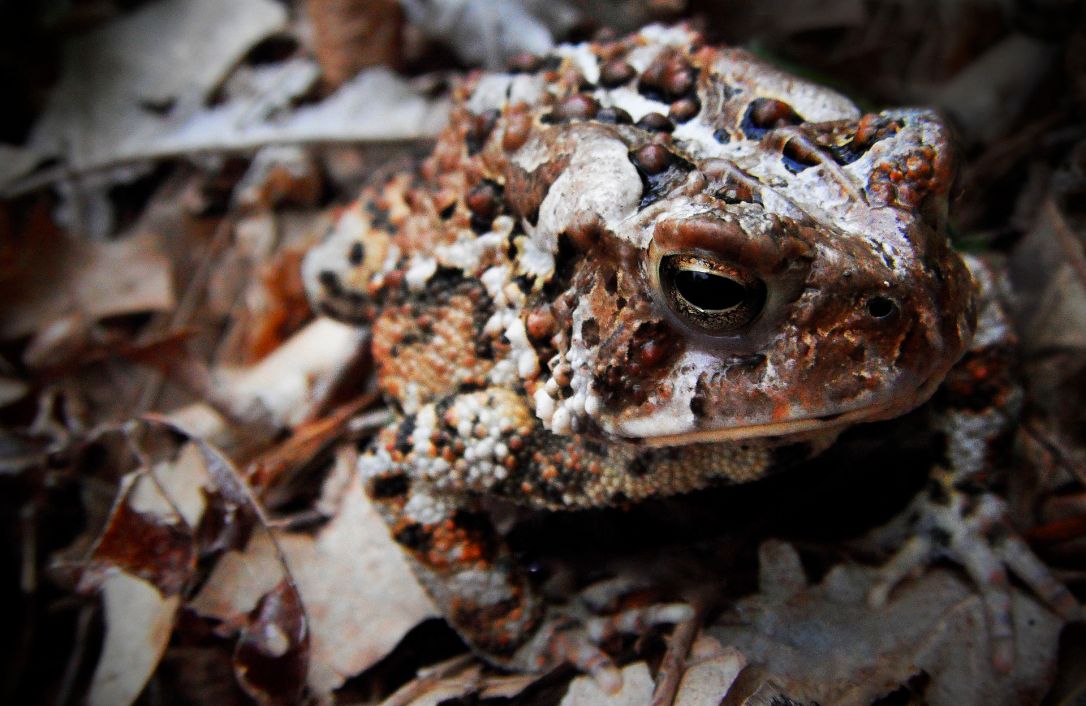
Common Name: Fowler’s Toad
Scientific Name: Anaxyrus fowleri
Location: Statewide
Breeding Season:
The Fowler’s Toad is a small to medium sized toad ranging in color from brown, gray, and olive with a clear, white underside and a white stripe down its back. Its parotid gland touches its postorbital ridge.

The American Toad’s parotid gland is separated from the cranial crest while the Fowler’s Toad’s touches.
Spadefoot Toad Family – Scaphiopodidae

Common Name: Eastern Spadefoot Toad
Scientific Name: Scaphiopus holbrookii
Location: Eastern half
Breeding Season:
The Eastern Spadefoot toad is the only Spadefoot toad in the state. If a toad has a spade on its rear foot, then its this toad.
Narrow Mouthed Toad – Microhylidae

Common Name: Eastern Narrow Mouthed Toad
Scientific Name: Gastrophryne carolinensis
Location: Southern part
Breeding Season:
The Eastern Narrow Mouth Toad is the only Narrow Mouth Toad in the state so the pointed narrow head is a key identifying trait.