
Toads and Frogs in Iowa
If you are looking to identify a specific toads and frogs in Iowa and can’t figure it out from the page, you can check my Frog Identification and see how to contact me about helping you out.
Iowa is home to a great variety of frogs and toads. In this article, I will show you all of them and tell you the differences between them.
Frogs in Iowa
Ranidae – True Frogs in Iowa
The True Frogs are your typical frogs that are generally found along the shores of a lake or pond.

Common Name: Crawfish Frog
Scientific Name: Rana areolatus
Location: Southern border of the state
Breeding Season:
The Crawfish Frog is a medium to large frog that is a light color but is covered in large dark spots. They have a white dorsal ridge that runs down their sides and a small tympanum. The Crawfish Frog gets its name from living in crawfish holes.

Common Name: Plains Leopard Frog
Scientific Name: Rana blairi
Location: Southern half
Breeding Season:
The Plains Leopard Frog is a medium sized frog with a tan color and dark spots. They have dorsal ridge that runs down their back that has a break and an indent near its butt / thighs.


Northern Leopard Frog (Rana pipiens)
Common Name: Northern Leopard Frog
Scientific Name: Rana pipiens
Location: Statewide
Breeding Season:
The Northern Leopard Frog is a medium to large species of semi aquatic species of frog. They vary in color from dark brown to slim green with fairly large spots all over their body.

Common Name: Southern Leopard Frog
Scientific Name: Rana sphenocephalus
Location: Southern border
Breeding Season:
The Southern Leopard Frog is a medium to large sized frog that is brown or green in color with spots over their body. They have a white spot on their tympanum and their dorsal ridge goes straight all the way down their back.

Common Name: Pickeral Frog
Scientific Name: Rana palustris
Location: Along the Mississippi River
Breeding Season:
The Pickerel Frog is a medium to large sized frog. Their dorsal ridge runs down from their eye to their back and inside there is rectangular boxes.


American Bullfrog (Rana catesbiana)
Common Name: American Bullfrog
Scientific Name: Rana catesbiana
Location: Statewide
Breeding Season:
The American Bullfrog is the largest frog in Iowa. They are found near permanent bodies of water such as large ponds, streams, and lakes. Once the males of the species reach sexual maturity, their throats turn bright yellow. They are very similar to Green Frogs but they don’t have a dorsal ridge down their back. It wraps around their tympanum.


Common Name: Green Frog
Scientific Name: Rana clamitans
Location: Eastern half of the state
Breeding Season:
The Green Frog is a medium to large sized frog that is green or bronze in color. They can be commonly found near pretty much any water body such as ponds, lakes, or streams. Once the males of the species reach sexual maturity, their throats turn bright yellow. Best way to tell them apart from other true frogs below is the dorsal ridge on its back does not go all the way down its back.
Hylidae – Tree Frogs in Iowa

Common Name: Blanchard’s Cricket Frog
Scientific Name: Acris blanchardi
Location: Statewide
Breeding Season:
The Blanchard’s Cricket Frog is a small, warty frog that varies in color from tan, brown, or green. They have a dark triangle between their eyes and a dark stripe on their thighs.


Cope’s Gray Tree Frog (Hyla chrysoscelis) and Eastern Gray Tree Frog (Hyla versicolor)
Common Name: Eastern Gray Tree Frog
Scientific Name: Hyla versicolor
Location: Statewide
Breeding Season:
Common Name: Cope’s Gray Tree Frog
Scientific Name: Hyla chrysoscelis
Location: Statewide
Breeding Season:
The Gray Tree Frogs are nearly identical besides their calls and chromosome numbers. These medium sized frogs can be found perched in trees or on the side of your house. They are not always gray in color and can be green. They have yellow or orange coloration on their back legs.
Here is a video of some Eastern Gray Tree Frog males calling that I took.


Spring Peeper (Pseudacris crucifer)
Common Name: Spring Peeper
Scientific Name: Pseudacris crucifer
Location: Eastern border
Breeding Season:
The Spring Peeper is a small chorus frog that can often be found on forest floor or low on trunks of trees. They can be hard to find due to their small size, however, in spring when they come to temporary ponds to breed, they are easier to find. They can be distinguished from Boreal Chorus Frog and Cricket Frog due to their x on their back.
Video of a Spring Peeper calling, thanks to M Dwyer, @MustelidDwyer on twitter


Boreal Chorus Frog (Pseudacris maculata)
Common Name: Boreal Chorus Frog
Scientific Name: Pseudacris maculata
Location: Throughout the state
Breeding Season:
The Boreal Chorus Frog is a small sized Chorus Frog, ranging from brown, red, tan, to olive in color. They are very similar to the Spring Peeper but there is no x on its back but three lines that run down its back. It is one of the first frogs to start breeding in the spring, once the ice melts from the ponds, but breeds the longest out of all species.
Toads
True Toad Family – Bufonidae
The True Toads are your standard, typical toad. They usually have a parotid gland behind their eyes that contain a poison called bufotoxin. It is not advised to let your dog eat these guys.


American Toad (Anaxyrus americanus)
Common Name: American Toad
Scientific Name: Anaxyrus americanus
Location: Statewide
Breeding Season:
The American Toad is a medium sized toad with rough warty skin that’s primary brown in color but can have some black, gray, or red coloration. Their undersides are speckled. The American Toads’s parotid gland does not touch or connected to it by a spur. The toads can be found pretty much anywhere including urban areas.

Common Name: Great Plains Toad
Scientific Name: Anaxyrus cognatus
Location: Northwestern part
Breeding Season:
The Great Plains Toad has V shaped cranial crest which is unique for the toads in the The Great Plains Toad is a medium sized toad with pairs of dark blotches down their back. The toads are brown, gray, or green in color. A white stripe down their back can be seen on some individuals. The toad has a V shaped cranial crest on their head with a boss (bump) in between the eyes.
Video of a male Great Plains Toad calling by Annika Enloe

Common Name: Woodhouse’s Toad
Scientific Name: Anaxyrus woodhousii
Location: Western edge of the state
Breeding Season:
The Woodhouse’s Toad is a medium sized toad with brown or gray coloring. They have a white or yellow stripe running down the center of their back. Their cranial crests do not touch, creating opposing L shapes.
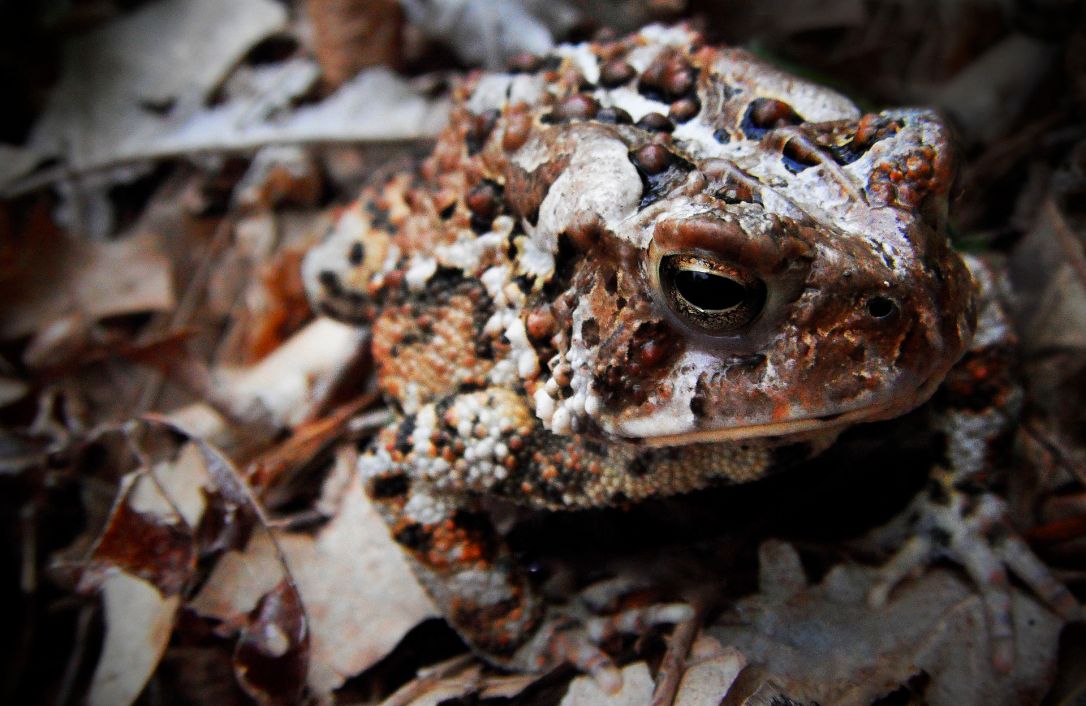
Common Name: Fowler’s Toad
Scientific Name: Anaxyrus fowleri
Location: Western border of the state
Breeding Season:
The Fowler’s Toad is a small to medium sized toad ranging in color from brown, gray, and olive with a clear, white underside and a white stripe down its back. Its parotid gland touches its postorbital ridge.
Spadefoot Toad Family – Scaphiopodidae

Common Name: Plains Spadefoot Toad
Scientific Name: Spea bombifrons
Location: Western border of the state
Breeding Season:
The Plains Spadefoot Toad is a small to medium sized toad that is gray, brown, or tan in color. They have elliptical, vertical pupils that are snake-like. The toad has a bony boss (bump between the eyes). Its spade has a round shape.